Thursday, May 19, 2011

Eve

Birthdays are a big deal in our home; it’s always a celebration marked by dinner out at a fancy-schmancy restaurant.

We’re in DC for my birthday celebration this year and Michèle has chosen Eve, located in Old Alexandria. The chef, Cathal Armstrong, is from Dublin and spent every summer from the age of 7 in France. He describes his style as “Modern American Cooking with Classical French Influences…highlighting the freshest of seasonal ingredients and local Virginia produce.” Right up our alley.

We spent the morning at the Newseum, which I highly recommend if you’re a newshound like me. There a great view of the Capitol and Pennsylvania Avenue from the 5th floor terrace. Wait, what’s that building with all the red and white flags next door? O Canada!


That evening, we’re in the Chef’s Tasting Room, where they offer five, seven, and nine-course prix-fixe tasting options, all on custom-printed menus. The courses are: Creation (palate teasers), Ocean (seafood), Earth & Sky (meats and game), Age (cheese) and Eden (desserts). Gulp. OK, we’re celebrating but we’re not crazy! 5 courses it is.

We start with glasses of Sauvignon Blanc, a classic wine for aperitif that also goes superbly with our First Course: Sashimi of Bigeye Tuna with Pickled Fennel, Ruby Red Grapefruit and Basil Emulsion for me; Tempura of Path Valley Shiitake with Ikura (salmon roe), Smoked Onions and Ponzu for Michèle.

Our Ocean course is Olive Oil Poached Pacific Halibut with Sunchokes (Jerusalem artichokes), Melted Spring Onions and Gremolata for Michèle. For me, it’s Roasted Tasmanian Sea Trout (so much for local!) with Baby White Asparagus Risotto, Kumquat, and Fava Bean Purée. Both are delicious and pair well with glasses of Chardonnay from Washington (not DC, the other one).

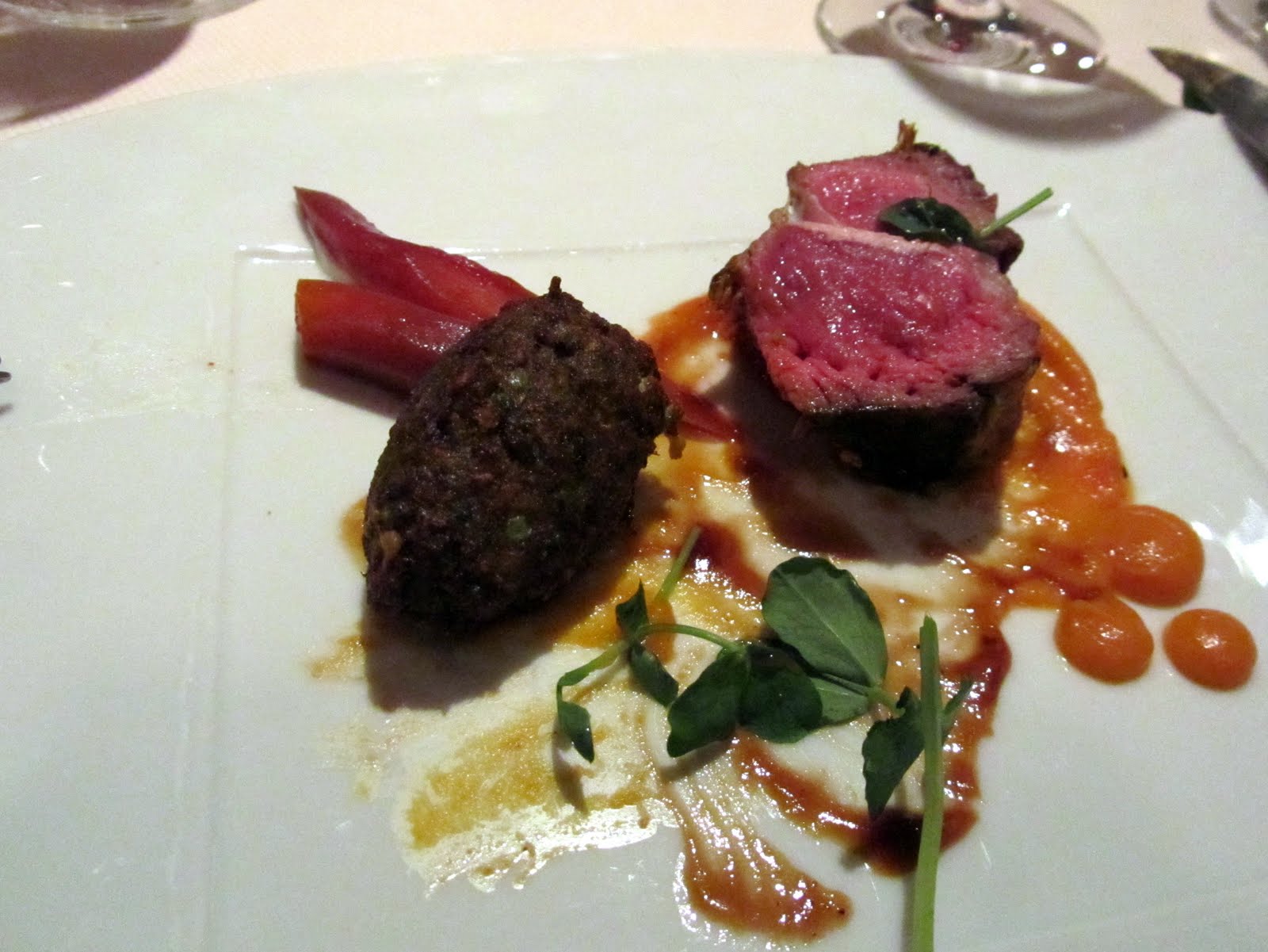
On to Earth and Sky. My choice is closer to local: Loin of Shenandoah Valley Lamb with Fresh Garbanzo Falafel, Homemade Yogurt and Baby Carrots. Michèle goes for one of her favourites, Pan Fried Veal Sweetbreads with Mushroom Butter Hollandaise, Poached Morels and Irish Peas.

I’ve scanned the winelist for something “off the beaten track” and the choice comes down to DuMOL Syrah 2007, Russian River Valley (California); 14.2% ABV. Russian River Valley is known for its cool climate varietals, but here’s Syrah, typically more at home in warmer climates. For that reason (a warm climate grape in a cool climate), I’m thinking it will go well with both the lamb and the sweetbreads (the latter usually needs a lighter wine). Aromas of blackberry and plum, gamy, and floral notes with a hint of dried herbs too. It’s black fruit and gamyness dominate on the palate. The tannins are well-integrated, holding their own with the lamb but not overwhelming the sweetbreads. Excellent finish. A good match for both.

We finish the Syrah with the cheese:
  • Monocacy Silver with Garden Rhubarb, Blood Orange and Toasted Walnut. A brie-style goat cheese from Montgomery County, on the other side of DC.
  • Pleasant Ridge Reserve with Sicilian Pistachios and Sour Cherry Filled Doughnut. A raw cows-milk cheese from Wisconsin, similar to Gruyere. Definitely our favourite.

On to Eden and, yes, we have room. Michèle selects the White Chocolate Chai Rice Pudding and my choice is the Milk Chocolate and Jameson Petit Gâteau with Caramel Sauce.  The candle is a bonus!

Great food, good wine.  What a terrific birthday treat!  Merci, Michèle!

Subscribing to this blog through RSS or email is easy! Just click on the subscribe link to the left ←

Tuesday, May 17, 2011

Kinkead's

It's one of those classic spring days, when the day dawns bright and sunny. You need a jacket in the morning, but you know that by mid-afternoon, the jacket will be off and you’ll be rolling up your sleeves.

It’s perfect weather for sightseeing and long walks, which in DC is the same thing.

Some sights (Washington Monument, Lincoln Memorial) I’ve seen many times before. Some are new since I lived here: World War II, Korean War, Vietnam War. All are impressive in their own way and all capture the historical essence that we associate with those wars: generational triumph, stalemate, and the deep gash in the national psyche.


We’ll be having a quick dinner this evening (we're off to see Pink Martini at the JFK Center).  So we make time for a long, leisurely lunch at Kinkead’s (pronounced as Kin-kaid), which styles itself as “an American Brasserie”. Seafood is the speciality.

For our mains, I choose grilled flounder, served on a bed of endives and tomatoes in a lemon sauce with capers and pickled cucumber on top. Michèle chooses the Organic Chicken, served with chanterelles, fava beans, porcini cream, and mashed potatoes. Both are superb.

The selected wine is the only Chenin Blanc on the menu: Couly-Dutheil Les Chanteaux 2009, AOC Chinon. Wonderfully fresh floral, citrus, and mineral aromas. It’s citrus and minerality on the palate with good length. Crisp, but with enough body to be a terrific match with both dishes. Great price too. Ah, Chenin Blanc from the Loire…so little respect…it’s one of the great values.


Great service that hit all the right notes. An example: they hadn't chilled the Chinon ahead of time, so the waiter gave us a couple of glasses of wine to enjoy while the Chinon chilled down to the right temperature in an ice bucket.

Watching crew teams on the Potomac
with the Watergate in the background
We walked off our terrific lunch through Georgetown, and then slowly made our way along the Potomac to the JFK Center, stopping to enjoy the sunshine along the way.  Jacket off, sleeves rolled up.

Great show by Pink Martini caps off a magnificent day.


Subscribing to this blog through RSS or email is easy! Just click on the subscribe link to the left ←

Wednesday, May 11, 2011

My Picks: Vintages Release -- May 14 2011

This release was a tough one. Never before have I encountered so much difficulty in finding out more about the wines in a release.

Just 2 weeks ago, I noted that some (too many) winemakers don’t devote enough time to their websites, which is their most important medium for connecting directly with consumers. Some don’t have a website at all, while others don’t keep their websites up to date, including some very big names. In this release, the famous Rhone winemaker Guigal is a surprisingly example of the latter case. (Mind you, I found 3 instances where the winemaker’s website featured the vintage after the one offered this week at Vintages. An example: Quails’ Gate features their 2009 Chardonnay on their website, but it’s the 2008 Chardonnay on the shelves this Saturday at Vintages. Where has the wine been?)

The upshot? Well, the theme of this week’s release is Southern Rhone 2009: a great year in a region that’s a personal favourite. But none of the winemakers met the criteria that I set in My Picks.

The secondary theme is rosé wines and 3 made the list. Whew.

Combing through the list, there are still some interesting choices.

Biodynamic

BONNY DOON BEESWAX VINEYARD LE CIGARE BLANC 2008, Arroyo Seco (California); #95331; Price: $29.95; 14.3% ABV
If a man loses pace with his companions, perhaps it is because he hears a different drummer. Let him step to the music which he hears, however measured, or far away. (Thoreau)
Randall Grahm, winemaker at Bonny Doon, marches to a different beat. He’s been one of my favourites for a long time, especially his rosé wine Vin Gris de Cigare, which shows up at Vintages from time to time. He specializes (not exclusively) in grape varieties of the Rhone Valley. This one is a blend of Roussanne (57%) and Grenache Blanc (43%). Roussanne often has an aroma of beeswax, hence the name.  Try it with some grilled portobello mushrooms.

Off the Beaten Track

Whites

KIM CRAWFORD UNOAKED CHARDONNAY 2009, Marlborough (New Zealand); #991950; Price: $17.95; 12.5% ABV
100% Chardonnay. That’s right, I’m recommending a Chardonnay. What makes this one different? It’s unoaked from a cool climate, the South Island of NZ. 80% Malolactic fermentation. Tasting is believing. Grill some fish.

DOMAINE GEROVASSILIOU WHITE 2009, Epanomi (Greece); #999714; Price: $19.95; 12.5% ABV
A blend of Assyrtiko and Malagousia, both native to the region (if you hadn’t guessed from the names). Assyrtiko brings minerality and citrus aromas and flavours; Malagousia brings more floral notes but lacks the acidity that Assyrtiko offers. They keep the juice on the skins for a few hours, then fermentation in stainless steel tanks. Perfect with grilled seafood. Drink soon.


Reds

D'ARENBERG THE LAUGHING MAGPIE SHIRAZ/VIOGNIER 2008, McLaren Vale (Australia); #936971; Price: $29.95; 14.5% ABV
A Cote-Rotie-styled blend of Shiraz (94%) and Viognier (6%). The two varieties are co-fermented in new and old French and old American oak barrels, followed by aging for 10 months on its lees in the same barrels. No fining or filtration, so decant this one. If you haven’t tried an Aussie Shiraz/Viognier blend yet, don’t pass this up. The Laughing Magpie refers to the local Kookaburra.

TOR DEL COLLE RISERVA 2006, DOC Montepulciano D’Abruzzo (Italy); #211847; Price: $ 12.95
100% Montepulciano. Fermentation for 10 days. Unusual: Aged 12 months in oak, 12 months in stainless steel. What a bargain! A perfect everyday wine for pasta and pizza with tomato-based sauce. Or maybe the next one is the perfect everyday Italian wine…

MAURO VEGLIO 2009, DOC Dolcetto D'Alba (Italy); #214486; Price: $16.95; 12.9% ABV
100% Dolcetto, the little sweet one. But it’s not sweet. Maceration for 4 days. Fermented off the skins in steel tanks, followed by Malolactic fermentation to soften the acidity. Left in the stainless steel tanks for 6 months, then put in oak barrels for 2 months to settle. Bottled without fining and filtration, so it might need decanting. Again, it’s great to have on hand with pizza or some sausages on the grill.

LAR DE PAULA RESERVA 2004, DOCa Rioja (Spain); #208207; Price: $21.95; 14.0% ABV
100% Tempranillo, aged 18 months in American and French oak, then 18 months in the bottle before release. It’s Tempranillo, it’s Rioja, it’s all you need to know. Worth cellaring.

ONDARRE RESERVA 2004, DOCa Rioja (Spain); #723452; Price: $19.95; 12.8% ABV
A blend of Tempranillo (75%), Garnacha (10%), and Mazuelo (15%). Fermented separately; maceration for 16 days. Aged 16 months in American and French oak barrels. Ready to drink now. I tried the 2002 Reserva last year with wild turkey and loved it.


Rosés

CHÂTEAU D'AQUÉRIA ROSÉ 2010, AC Tavel (France); #319368; Price: $18.95; 12.9% ABV
For many, it’s Tavel that’s the classic rosé! A blend of 4 red grape varieties and 3 white grape varieties: Grenache (52%), Syrah (12%), Mourvèdre (11%), Cinsault (9%), Clairette (9%), Bourboulenc (6%), and Picpoul (2%). Hand harvested, then maceration for 24 hours. All vinified separately with natural yeasts, blended two by two (which two, I don’t know), then they're all blended together. The Tavel designation is for rosé only. Aquéria is the largest estate of Tavel.

MAS DES BRESSADES CUVÉE TRADITION ROSÉ 2010, AC Costières de Nîmes (France); #950576; Price: $13.95; 13.5% ABV
A blend of Grenache (50%), Syrah (30%), and Cinsault (20%). Fermented in stainless steel tanks using the Saignée method, where they bleed the juice off the grapes after a day or so.

MUGA ROSÉ 2010, DOCa Rioja (Spain); #603795; Price: $12.95; 13.0% ABV
The 2009 was one of my favourite rosés from last year. The blend of Garnacha (60%), Viura (30%) and Tempranillo (10%) is unchanged from 2009. Viura is a white variety. 12 hours of maceration, followed by fermentation for 25 days in 1000-litre oak vats, then left to age in the same vats for 2 months before bottling.


Sparkling

MASOTTINA EXTRA DRY, DOCG Conegliano Valdobbiadene Prosecco Superiore; #216317; Price: $19.95; 10.7% ABV
Spring is the season of celebrations: weddings, anniversaries, graduations, and more. And nothing says celebration like a sparkling wine. Not looking to break the bank? Here’s your choice. Conegliano Valdobbiadene Prosecco Superiore is one of Italy’s newest DOCGs (Denominazione di Origine Controllata e Garantita). Whether expanding the list of DOCGs is good is a matter of opinion. What’s not debatable is that Prosecco offers great value in a sparkling wine. Made using the Charmat method (fermentation occurs in large stainless steel tanks) it’s crisp and clean, not too high in alcohol. Up until 2009, when the Italian government granted DOCG status to Conegliano Valdobbiadene, Prosecco was the name of the grape and the wine. Because other growers outside Conegliano Valdobbiadene also used the same grape, they changed the name of the grape to another traditional name, Glera.  So now Prosecco is the wine, Glera is the grape.

Subscribing to this blog through RSS or email is easy! Just click on the subscribe link to the left ←

Tuesday, May 10, 2011

J&G Steakhouse

Sightseeing is hard work, requiring stamina, determination, and at the end of the day, a culinary reward.

In Washington DC, there are many things to see: from the White House to Capitol Hill, everything in-between and beyond. To be sure, you can walk everywhere. But careful…it all looks close together on the map and even in person. But because the scale of everything is so grand (quite the opposite of the intimacy of Ottawa’s downtown), objects actually are farther away than they appear.

Luckily, DC has an excellent metro system. Back when I lived here, the public transit system was a local joke. It’s just one of the many things in DC that have changed for the better.

As for our reward at the end of the day, we needed steak. There’s no shortage of steakhouses in this red meat town. We bypassed the usual suspects and opted for J&G Steakhouse, just a stone’s throw from the White House. (Not that I tried throwing stones at the White House. Ill-advised, they tell me.)

J&G Steakhouse is a Chef Jean-Georges Vongerichten restaurant. (Vongerichten is an Alsatian who is now one of those worldwide chefs.) After a salad as an appetizer, I chose the 14 oz Six Peppercorn Prime NY Steak with sides of Frites and sautéed kale while Michèle selected the 8 oz Filet Mignon. For me, steak needs to have good body and texture. Rib Eye, Hanger, New York, that’s a steak. I don’t care for steak disguised as melted butter, which is what Wagyu can often be. My steak had just the right amount of chewy texture that makes steak so enjoyable.

Our wine is the Cliff Lede Cabernet Sauvignon 2007 Stags Leap District, 14.9% ABV. It’s an almost-Meritage blend of Cabernet Sauvignon (75%), Merlot (12%), Malbec (7%), Cabernet Franc (4%), and Petit Verdot (2%). Aromas of cassis, sweet spices, and a touch of earthiness. The cassis and spice follow on the palate with soft, well-integrated tannins. Some dark chocolate on the finish. No unpleasant heat from the high alcohol level. Good length, but perhaps lacks the structure I like with a good steak.


Service at J&G is quite the opposite of our dinner at Hank’s Oyster House. Friendly, efficient, unobtrusive and, most importantly, unhurried. Oh, I’m sure they can rush an order if called upon. But, for us, we finished our wine leisurely after the main course. No sign of the dessert menu until the wine was gone. The way it should be. The restaurant was full but we felt we could have stayed there as long as we wanted.


Subscribing to this blog through RSS or email is easy! Just click on the subscribe link to the left ←

Wednesday, May 4, 2011

Hank's Oyster Bar

It’s weird to be back in Northern Virginia, in the suburbs of Washington DC. It’s where I went to high school, oh so many years ago. And except for some quick business trips to DC from time to time, I haven’t come back until now. There’s a familiarity to the place, a feeling of déjà vu. Yet so much has changed that there’s a certain strangeness, or estrangement, to the place. Like a dream.

It’s spring here. Real spring, not calendar spring.  Driving south from Ottawa, near Scranton, we can see the sharp demarcation between winter and spring, between dormancy and budburst. 

Our first dinner is at Hank’s Oyster Bar in Alexandria. It’s a popular little joint; crowded on a Tuesday evening. We get the only open table and the line-up starts forming at the door just after we sit down. But it has that typically American approach to service…fast, get ‘em in…get ‘em out…that ensures that no one is waiting for long.

It’s an oyster bar so regular readers should be in no doubt about what I’m going to order. There are 9 different types of oysters on offer. I take a dozen, 3 each of 4 different ones.

Two from the west coast:
  • Dabob Bay, light and salty
  • Little Skookum from Puget Sound, smooth and rich
Two from the east coast:
  • Bluepoint from Long Island, nothing distinctive here
  • Delaware, big and meaty
Now, Hank’s does something that I’ve never seen at an oyster bar before but it’s blindingly obvious. Instead of plunking down the plate of oysters and rattling off the names (which I can never remember just 10 seconds later), the server puts the plate down with the order ticket next to it. The shucker arranged the oysters on the plate in the same order as on the ticket, clockwise, starting at 12 o’clock. Simple, effective, clever.  No "what was this one again?"

We order Nessa Albarino 2009. Bit of a greenish tint. Typical citrus, floral, and mineral aromas. Crisp lime on the palate and just a bit of peach pit bitterness on the finish. Great match for the oysters.

I followed up with seared scallops while Michèle had the lobster roll. The food was delicious (bit too salty) but the Albarino was too light-bodied with these choices.  Ah well, nobody's perfect.

Hank’s: good oysters, good (but too fast) service.


Subscribing to this blog through RSS or email is easy! Just click on the subscribe link to the left ←

Thursday, April 28, 2011

My Picks: Vintages Release -- April 30 2011

The primary theme of this week’s release is “Aussie Dynasties” with 21 wines from various family-run wineries. Good variety and some good Picks. 3 make it here.

Southern Italy is the supporting theme. It’s one of my favourite areas, full of indigenous grape varieties that we don’t see elsewhere. 3 more of My Picks come from this region.

At last, we’ve got some organic and Biodynamic wines to snap up from this release: 4 of them (one from Ontario) made the cut. The word “sauvignon” shows up in all 4.

Selections from Chile and Spain round out the list.

Learn more here about My Picks.


Organic & Biodynamic

PAUL DOLAN SAUVIGNON BLANC 2009, Mendocino County (California); #46334; Price: $19.95; 13.5% ABV
100% Sauvignon Blanc from Mendocino County, north of Sonoma along the Pacific coast. Fermented and aged in stainless steel. Certified organic by CCOF (California Certified Organic Farmers). Paul Dolan has a Biodynamic wine, but this isn’t it. Try it with sushi. Check out this Wine Spectator video with the winemaker.

CONO SUR SAUVIGNON BLANC 2010, San Antonio Valley (Chile); #213587; Price: $12.95; 13.5% ABV
100% Sauvignon Blanc from San Antonio, way up north in Aconcagua but just 20 km from the coast, so it’s influenced by the cold waters of the Humboldt current, ideal for Sauvignon Blanc. Handpicked. Fermented and aged, for 3 months, in stainless steel. Certified organic by BCS Oeko Garantie GMBH of Germany. They say the bicycle on the label represents the method of transportation used by the workers to get to the vineyards. Great value.

SOUTHBROOK TRIOMPHE CABERNET FRANC 2008, VQA Niagara-on-the-Lake; #237065; Price: $22.95; 13.3% ABV
A blend of Cabernet Franc (85%) and Cabernet Sauvignon (15%). Hand-harvested. Fermented in both stainless steel and oak vats with indigenous yeasts for four weeks. Aged in French and American oak. No fining. Certified Biodynamic. Anybody for some steak tartar?

NATIVA SINGLE VINEYARD GRAN RESERVA CABERNET SAUVIGNON 2007, Maipo Valley (Chile); #975359; Price: $19.95; 14.0% ABV
100% Cabernet Sauvignon. Cold macerated for 2 weeks, then fermented in stainless steel tanks. Aged in French oak barrels for 14 months. Certified organic by the IMO (Institute for Marketecology). No synthetic pesticides or fertilizers. Perfect with a grilled steak.


Off the Beaten Track

White

YALUMBA VIOGNIER 2009, Eden Valley (Australia); #954644; Price: $24.95; 13.5% ABV
100% Viognier. Fermented with indigenous yeasts: 60% barrel-fermented, 40% fermented in stainless steel. Aged on its lees for 10 months in older French oak barrels. The winemaker recommends “anything lamb” with this wine. Well, the Aussies know lamb and they know wine, so why not?

Reds

VIÑA PERALILLO ARENAL CARMENERE 2009, Colchagua Valley (Chile); #211409; Price: $14.95; 14.0% ABV
100% Carmenère. Hand-harvested. Just a touch of oak: 30% of the wine aged in first- and second-use barrels for 6 months. It’s a wine for (slow-cooked) ribs on the BBQ.

D'ARENBERG THE TWENTYEIGHT ROAD MOURVÈDRE 2007, McLaren Vale (Australia); #677617; Price: $29.95; 14.5% ABV
100% Mourvèdre, a warm climate grape that’s easy to find in southern Rhone, Languedoc-Roussillon, and Spain. Typically high in acidity and tannins, it’s a black-fruit, spicy mouthful. Fermented in old French oak vats and barrels. Aged for 10 months in French and American oak barrels on its lees. No fining or filtration, so decanting is a must. Needs aging. I’m thinking of some game…venison on the grill?

HOWARD PARK LESTON CABERNET SAUVIGNON 2008, Margaret River (Australia); #923565; Price: $29.95; 14.0% ABV
100% Cabernet Sauvignon from Western Australia, a region that is overlooked, or simply lumped in with Southern Australia (a little like confusing Okanagan with Niagara). Fermented in stainless steel tanks, then left on its skins for another 20 days. Aged in French oak barrels (35% new; 65% 1-year-old) for 18 months. Minimal fining and filtration. Decant. Leave it in the cellar for at least a year or two.

TERREDORA AGLIANICO 2008, IGT Campania (Italy); #602284; Price: $14.95; 13.0% ABV
100% Aglianico...find out what you’ve been missing, for only $15. Maceration for 7 days. Aged partially in oak and partially in stainless steel tanks. Why not try it with some pizza?

LEONE DE CASTRIS RISERVA 2006, DOC Salice Salentino (Puglia); #597534; Price: $16.95; 13.5% ABV
A blend of Negroamaro (90%) and Malvasia Nera (10%). Handpicked. Maceration for 8 days. Aged 12 months in oak barrels, 3 months in bottle before release. Another wine for a tomato-based sauce.

FIRRIATO ROSSO 2008, DOC Etna (Sicily); #219592; Price: $16.95; 14.0% ABV
A blend of Nerello Mascalese (80%) and Nerello Cappuccio (20%), both of which they usually blended with Nero d’Avola. Handpicked. Fermented for 14 days in stainless steel. Aged 6 months in oak barrels, followed by 2 months in the bottle before release. I’d try it with pasta with a meaty sauce or a lamb stew…so you may want to save it for next winter.

DON JACOBO GRAN RESERVA 1995, DOCa Rioja (Spain); #923748; Price: $27.95; 12.5% ABV
That’s right…1995. The tradition is that this is the way that winemakers release wines in Rioja: the winery holds on to the wine until it’s at its peak. A blend of Tempranillo (85%) and Garnacha (15%). Hold onto it until next winter and try it with a stew or braised meat.

Subscribing to this blog through RSS or email is easy! Just click on the subscribe link to the left ←

Wednesday, April 27, 2011

The Facts, Ma'am, Just the Facts

I’ve been away for a couple of weeks, down south visiting another national capital and tuning up the golf game in anticipation of sunny, warmer days here in Ottawa.

I avoided checking email and Canadian news while I was away. Disconnecting for a while surely does have its charms, although coming home to hundreds and hundreds of emails is somewhat discouraging. And some kind of orange wave apparently is about to swamp Canadian politics.

One goody that I came across while catching up on things was this commentary by Decanter’s Andrew Jeffords, in which he bemoans the abysmal state of winery websites.

I couldn’t agree more.

If it isn’t already so, winery websites are rapidly becoming THE primary medium for how consumers learn more about an individual wine, particularly when portable web technology is at so many fingertips.

As Jeffords points out, people who take the time to visit a winery’s website want to know some fundamental things about the wines: the terroir, the grapes, vinification techniques, tasting notes, and food suggestions. Pretty pictures, music, and stories about winemaker’s dogs…these are all OK as add-ons but if you don’t have the fundamentals on each of your wines, you’re wasting our time.  Canadian wineries are some of the worst offenders.

The second great sin of many winery websites is stale information. I cannot count the number of wineries that have made the “one-shot” effort to launch a website, only to down tools at that point, with their latest vintage reports anywhere from one to ten years out-of-date.

The formula for a good winery website is simple: tell us about the wine, all the wine, and nothing but the wine. Keep it up to date.

Subscribing to this blog through RSS or email is easy! Just click on the subscribe link to the left ←

Wednesday, April 20, 2011

Corked!

Sometimes you need a bad experience with a wine to remind you of how much some things have improved.

Back in the 80s, when I really started getting interested in wine, it wasn’t that unusual to get a bottle of wine that was “corked”; i.e., spoiled by a cork that was infected with 2,4,6-trichloroanisole (TCA to its enemies…it has no friends). Conventional wisdom and common experience was that poor quality corks spoiled around 1 out of 8 to 12 bottles. That frequency has gone down, thanks to two factors: the rise of screwcaps and artificial corks as well as improvements in the quality control over corks. Certainly, my experience is that corked wines are fewer and farther between.

But memories of the bad old days came back to us a couple of weeks ago when we opened a bottle of Chateau Leoville Las Cases, AC Saint-Julien 1986 to celebrate the 25th anniversary of our first date. (Chateau Leoville Las Cases is a second growth Bordeaux from the famous 1855 classification.)

It’s a wine that I had bought about 20 years ago in anticipation of just this occasion. Storage conditions were faultless.

But I was somewhat suspicious about its condition as I noticed that the cork had pushed its way slightly above the lip of the bottle (maybe a couple of millimetres).

We took the wine to Beckta to celebrate. But after the folks at Beckta very carefully removed the cork, it was clear that the cork was in poor condition: mouldy and damp.

The wine was undrinkable (we did try), perhaps the worst case of cork taint (old, wet cardboard) that I can recall, even though its colour was still surprisingly youthful with no signs of aging even after 25 years. Much like us (ahem).

Fortunately, we had ready access to Beckta’s wine cellar and the evening remained celebratory in spite of our disappointment with the wine.

But it was a strong and smelly reminder of how disappointing wines from that era could be, and how poor quality control was, even at a top winery.


Subscribing to this blog through RSS or email is easy! Just click on the subscribe link to the left ←

Wednesday, April 13, 2011

My Picks - Vintages Release: April 16 2011

I didn’t find the selection of theme wines (from New Zealand) that compelling and none of them made it onto My Picks.

But 3 organic wines did make it, after an absence for 2 months of pick-worthy organic wines.

Organic & Biodynamic

GRGICH HILLS FUMÉ BLANC 2009; Napa Valley (California); #346296; Price: $29.95; 13.0% ABV
100% Biodynamic Sauvignon Blanc. What turns Sauvignon Blanc into Fumé Blanc? Oak! Fermented in 900-US-gallon oak casks (80%) and neutral (used 3+ times) French Oak barrels (20%). Aged for 6 months on its lees in neutral barrels. Try it with a light, white fish or roast pork tenderloin.

FATTORIA LA RIPA 2008, DOCG Chianti Classico (Tuscany); #651596; Price: $18.95; 13.0% ABV
A blend of Sangiovese (90%) and Canaiolo (10%). Aging in oak casks, then in the bottle before release. Made from organic grapes. Try something “Classico” like pasta in tomato sauce.

FATTORIA LA RIPA 2006, DOCG Chianti Classico Riserva (Tuscany); #984401; Price: $26.95; 13.5% ABV
This Riserva is from the same producer as the “regular” Chianti Classico listed above. Also a blend of Sangiovese (90%) and Canaiolo (10%). Traditional fermentation and aging in oak casks for 2 years, then in the bottle for 6 months. Made from organic grapes. This wine deserves something more substantial, like steak Florentine.

Off the Beaten Track

Whites

DORNIER DONATUS WHITE 2009, WO Western Cape (South Africa); #597278; Price: $18.95; 13.5% ABV
An interesting blend of Chenin Blanc (77%) and Semillon (23%). Separately fermented in new and second-use French oak. Aged 8 months on their lees in the barrel. Match to a heavier fish, like swordfish…only sustainable.

LES PILIERS VIOGNIER 2009, (Languedoc); #669531; Price: $15.95; 13.0% ABV
100% Viognier. Hand harvested. Skin contact for 12 hours. Fermented in stainless steel, then aged on its lees. No oak. Fined and filtered. Drink now with seafood in a cream sauce.

MICHELE CHIARLO LE MARNE GAVI 2009, DOCG Gavi (Piedmont); #228528; Price: $14.95; 12.5% ABV
100% Cortese grown in a maritime climate. Fermented with indigenous yeasts, with part cold maceration. No oak. Light, fresh. Is summer here yet?

Reds

MAS DES DAMES LA DAME 2008, AC Coteaux du Languedoc (France); #223214; Price: $15.95; 13.5% ABV
A blend of Grenache (50%), Syrah (30%), and Carignan (20%). Hand harvested. Fermented in cement tanks, then left on its skins for 5 weeks. Aged in cement tanks. No oak.  Try it with lamb chops.

CARPINETO 2004, DOCG Vino Nobile Di Montepulciano Riserva (Tuscany); #368910; Price: $28.95; 13.0% ABV
A blend of Prugnolo Gentile, aka Sangiovese, (70%) and 30% Canaiolo (although they are allowed to throw a few other varietals into the blend).  Maceration on the grape skins for 10 days. Aged 2 years in 5,500 litre Slovenian oak barrels, with a small quantity aged in French oak barrels. Aged for 12+ months in bottle before release.

ENCOSTAS DE ESTREMOZ QUINTA DA ESPERANÇA 2005, Vinho Regional Alentejano (Portugal); #160465; Price: $13.95; 14.0% ABV
A blend of Touriga Nacional (70%), Trincadeira (20%) and Aragónes (10%), all indigenous Portuguese grapes. Fermented for 8 days, followed by 12 days of maceration. Aged for 7 months in new American and French barrels.

ONTAÑÓN RESERVA 2004, DOCa Rioja (Spain); #725895; Price: $24.95; 12.4% ABV
A blend of Tempranillo (95%) and Graciano (5%). Aged 24 months in French and American oak.

VIÑAS ELIAS MORA 2008, DO Toro (Spain); #209650; Price: $18.95; 14.5% ABV
100% Tinta de Toro (aka Tempranillo). Aged just 6 months in American oak. Drink it ASAP.

Sparkling

RAVENTÓS I BLANC L'HEREU RESERVA BRUT CAVA 2007, Spain; #221796; Price: $19.95; 12.2% ABV
A blend of Macabeo (60%), Xarel-lo (20%), and Parellada (20%). Hand harvested and fermented using the traditional method with 15 months of bottle aging. Great value.

Subscribing to this blog through RSS or email is easy! Just click on the subscribe link to the left ←

Thursday, April 7, 2011

What's Wrong with Tasting Notes - Part 3

I've ranted here and here about wine tasting notes.

OK, then, what should be in a tasting note?

Let’s start by getting rid of the pretence of objectivity in wine tasting. Too much of wine tasting, and the descriptions that flow from it, attempts to portray the subjective experience (or intensely private sensation) as an objective analysis. Wine tasting is mostly subjective; it varies not only from one person to the next, but varies from bottle to bottle, glass to glass, sip to sip. (Mind you, I had more than one Prof who insisted that there was only one right answer to “what do you taste in this wine?” Of course, that one right answer was the Prof’s answer.)

Are there objective aspects that we can bring to the description of a wine? I think there are. Describing terroir is objective. Describing climate is objective. Describing vinification is objective. These are factors that can explain why a wine tastes the way it does.

Tasting notes need a balance of the subjective and the objective. Terroir…climate…vinification. That’s objective. But yes, explain how a wines tastes. That’s subjective. Don’t over-specify. Don’t impress us with your tasting vocabulary. Perhaps it reminds you of an experience. (I’ve written before about how often tasters will refer back to aromas and tastes from childhood.) But explain why it tastes that way. Use the objective factors to help explain the subjective experience.

Be mercifully brief. Not as brief as Eric Asimov’s deliberately provocative suggestion of “sweet or savoury”.

Be uncomplicated.

I come back to what wine drinkers want to know: Will I enjoy the wine? Is it worth the price? What food, if any, would go well with it?

Will I enjoy the wine?
A wine drinker should be able to get a good sense of how the wine tasted. Condense the wine tasting analysis down to the essence.
  • Describe the dominant aromas and flavours. Remember, it’s not a shopping list. Don’t get me wrong; unlike a well-known wine reviewer here in Ottawa, I still want aromas and flavours in the description. Use evocative but familiar references. The more specific a descriptor is, the more useless it becomes. For example, “floral” is good; “rose” should be OK; “Wild Rose of Alberta” is too obscure … unless your audience grew up on the Canadian Prairies. (Coco Krumme at slate.com has a great example from Parker’s latest edition, which describes a Bordeaux wine as having “notes of graphite, black currant liqueur, incense, and camphor”. Evocative? Yes. Familiar? Not to me! Parker not only pioneered the 100-point system; he also pioneered over-the-top wine descriptions.)
  • Tell us about structure and texture, but only the foremost features.
  • Above all, please, please, please, we need to know about complexity and balance.
Is it worth the price?
I’m not a fan of numerical scoring; it’s subjective, inconsistent, and are we really supposed to believe that there’s a discernible difference between 89 and 90? But wine drinkers want an assessment of “value for money”. (“Why should I pay $60 for a 90-point wine if I can buy one for $20?”) But if value for money is subjective, then what’s wrong with a simple “Yes, worth the money” or “No, pass it by” as part of the conclusion?

What food, if any, would go well with it?
Tricky, this is. Creating great food and wine pairings requires imagination, experience, and knowledge of cuisine. It’s one reason that many sommeliers spend time in the kitchen. It’s a great way – maybe the only way – to learn. And yes, very subjective. But although great matches may be elusive, good matches are not.  The key in a tasting note is simplicity and familiarity.  If we don’t want you to impress us with your tasting vocabulary, we don’t want you to impress us with your culinary knowledge either.
Is this a “food wine” or not? Many wines from the New World show better without food. Other wines, mostly from the Old World, are better with food, particularly food from the same region. It’s no accident; regional cuisines and regional wines developed in tandem; they make their wines to go with their regional food.

Brevity, simplicity, familiarity, relevance…that’s what we need in tasting notes.

For more on what's wrong with tasting notes, check out one of my favourites bloggers...Alder Yarrow...who has 2 recent related posts, one on tasting notes and the other about Gerald Asher on Wine Writing.

Subscribing to this blog through RSS or email is easy! Just click on the subscribe link to the left ←