Showing posts with label reviews. Show all posts

Monday, April 30, 2012

Atelier


Michèle and I go out to dinner for different reasons at different times.  Sometimes we want comfort food.  Sometimes it's a place that’s quiet enough to carry on a conversation with friends.  Maybe we want something from a remote part of the world.  Or we want to experience the craft of a chef at the top of his game.  But the number one reason that we go out to dinner is to enjoy something that we know we could not do at home, something that no one else in town is doing, something that makes us say, “Wow, how do they do that?!”

In Ottawa, there are many places for comfort food.  We’re also blessed with many restaurants that offer food from every corner of the globe.  And the last 15 years have seen many very talented chefs develop their skills here.

But there’s one place in Ottawa that, right now, challenges, mystifies, thrills, and satisfies us more than any other:  Atelier.

Atelier offers only one choice:  a blind 12-course small plate menu.  Each course is a surprise; they disclose and explain the dish only as it arrives.  (They do ask beforehand if you have any allergies or dislikes.  A skinny woman at a nearby table inexplicably asked for no carbohydrates!  And no citrus because she was doing the colon cancer check.  Oh gawd, just stay home.)

This week marked our second trip to Atelier.  We first went soon after it opened late in 2008.  I won’t go into the “cooking” techniques used at Atelier, mainly because they’re so nontraditional that I’m sure that even if I tried to explain them, I’d come up way short.  But that’s the point.  We can’t do this at home.  It’s creative, it’s challenging, it’s amusing, and it’s superbly delicious.  We’re not alone in our opinion.  Atelier’s chef, Marc Lepine, won the Canadian Culinary Championship earlier this year.  The winning dish is on the menu.


What completes a wonder-ful experience is the matching wine pairing, a bargain at $60.  Much care obviously goes into selecting wines to match the dishes.  Kudos to the sommelier, Steve Robinson, who was in my sommelier class at Algonquin.  He’ll indulge your wine nerdiness if you want that, but he won’t bore you with details if you don’t.

Atelier is not inexpensive.  But compared to some other places in town and for the experience, we think it’s a bargain.  Save up if you have to.   But go.

Subscribing to this blog through RSS or email is easy! Just click on the subscribe link to the left ←

Thursday, January 26, 2012

Recommended Reading: To Cork or Not to Cork


Bringing wine to the consumer is a long, risky road.  From the vineyard, where weather can make or break a vintage, through harvest and fermentation, where a wine producer can meddle too much (and occasionally too little), to aging (how long and in what), and finally to bottling and transport, there are hundreds of risky choices to be made.

Bottling?  What’s the risk there?  It turns out that bottling, or rather how the bottle is sealed, can be the biggest risk of all.

That’s the story of To Cork or Not to Cork:  Tradition, Romance, Science, and the Battle for the Wine Bottle.  (Don’t worry…the editor did a better job on the rest of book than with the title.)  George Taber, who previously brought us Judgment of Paris, takes us through the history of the cork as a wine bottle closure and the why and how of alternative closures, such as the screwcap.

Ever had a bad bottle of wine?  Chances are that the wine itself was not inherently bad.  Odds are the wine was “corked”.  “Corked” refers to that unpleasant, musty, wet cardboard smell that can obliterate any other aroma that a wine should have.  Smell it once and you’ll never forget it.  (Read my own sad story about a corked wine here.)

Most often, cork taint happens when a chloroanisole (there are different ones, the most common is trichloroanisole – TCA) is present in the cork or, less commonly, in the cellar.  In the former case, Taber says that tainted corks affect from 3-5% of all wines that have a cork stopper.  In the latter case, the effect on a winery can be devastating, with entire vintages poured down the drain or, in the case of Chateau Latour, rebuilding the entire winery.

Back in 1970s, a corked wine was a comparatively rare occurrence.  Then, starting with the 1986 vintage, a minor problem became a major one as the incidence of corked wines shot up.  Why?  Worldwide demand for wine was increasing, many new producers entered the market, and the need for the traditional bottle closure – cork – went way up.  To meet that demand, cork producers threw quality control, which had never been their strong point, out the window.  Even more infuriating for the wine consumer, many wine producers – even the top ones in Bordeaux  – engaged in a shameful industry-wide hush campaign, refusing to admit that any problem existed, often ascribing the “problem” to uneducated wine-drinkers.  Taber quotes Hugh Johnson,
If all wine-drinkers recognized it, and rejected every tainted bottle, the wine-trade would go bust.  It is worrying to think that its profits depend on its customers’ ignorance.
By the time I finished reading these chapters on the complacency within the cork industry and the cover-up by wine producers, I was ready to swear that I would never again buy a wine with a cork stopper.

This conspiracy of silence existed for 20 years, consumers be damned!  Some producers, especially in Australia and New Zealand, rebelled and began to search for alternatives:  agglomerated corks (still risky for taint), synthetic and plastic corks (poor seals, not suitable for wines meant for aging), crown caps (cheap image), glass stoppers (elegant…my favourite), and cork’s main competitor, the screwcap.  Taber takes us through each one of these closures, with their advantages and disadvantages.

In the case of screwcaps, the biggest disadvantage is reduction:  the airtight seal traps ongoing chemical reactions in the bottle that can result in various unpleasant sulphur compounds.  (Cork allows these odours to escape over time through the gradual exchange of oxygen.)  But these aromas of rubber and rotten eggs tend to be less recognizable than cork taint.

Which is better, cork or screwcap?  Which evil is lesser?

That’s where Taber leaves us.  Cork producers have improved quality control, but cork taint continues to exist because hundreds of slipshod cork producers are still in business.  Each type of closure has its rabid supporters.  But none of the closures is foolproof, and research continues.

It’s a great read and very well-researched, although you may have to be a wine fanatic to get through every page.  But if you are a fanatic, you’ll love it.

Subscribing to this blog through RSS or email is easy! Just click on the subscribe link to the left ←

Thursday, July 14, 2011

Recommended Reading: A Hedonist in the Cellar

A few months back, I read Bacchus & Me, a collection of columns about wine that novelist Jay McInerney (Bright Lights, Big City) originally wrote for House & Garden magazine back in the 1990s. I wasn’t impressed. Collections of magazine columns can often be repetitive as this one was. (I expect an editor of collections to eliminate repetitions, inconsistencies, and other faults that are excusable when writing month to month, but irritating when collected within a single set of covers.)

McInerney just seemed to fall into the wine writing gig.  The magazine editor was a friend and, in his editor’s circle, McInerney was the guy who knew more than anyone else did about wine.  Colour me green.  Many of the essays came across as unsophisticated, yet snobby and self-indulgent. But perhaps I’m not the typical House & Garden reader. (House & Garden disappeared a few years back but Jay McInerney still writes about wine at the Wall Street Journal.)

But it takes more than one unsatisfactory effort to keep me from writings on my favourite subject. So I picked up McInerney’s second collection of essays, entitled A Hedonist in the Cellar.

It’s a much better standalone effort, showing a level of knowledge and appreciation that was missing from the first collection. It’s as if the first book was training camp and the second book was the playoffs. Maybe it’s because McInerney spends much more time writing about lesser-known wines and regions (“off the beaten track” if you will) that the columns have more appeal. You can actually learn something from this book!

He had me hooked from the first column, My Favourite White, where he praises Condrieu, a white wine made from Viognier grown in Northern Rhone. And he follows this up with an essay about Friulano, the food-friendly minerally white Varietal from Friuli in northeastern Italy, which we rarely see here in Ontario.  McInerney compares it to a blend of Riesling and Sauvignon Blanc.

He introduces (or maybe re-introduces) us to a wide variety of regions and wines, giving some overlooked gems their rightful appreciation.  Anybody who loves Sagrantino di Montefalco knows his stuff.  And in the section, Lovers, Fighters, and Other Obsessives, we meet some of the eccentrics of wine. My favourite is Michel Chapoutier (from the Rhone Valley) who is responsible for the two best quotes in the book:
The perfect match for asparagus is my competitors’ wines.
[W]hen one of his guests [McInerney, it turns out] struggles to identify the components of a wine’s bouquet in the tasting room he urges him to relax and just enjoy the wine. “If you think about it too much you can kill it. The brain is a pleasure killer. You don’t need to be a gynaecologist to make love.”
He (or his House & Garden editor) toned down the self-indulgency and snobbism from the first volume, and the sophistication, as should be expected, has grown.

Skip Bacchus & Me, go directly to A Hedonist in the Cellar.

Subscribing to this blog through RSS or email is easy! Just click on the subscribe link to the left ←

Thursday, May 19, 2011

Eve

Birthdays are a big deal in our home; it’s always a celebration marked by dinner out at a fancy-schmancy restaurant.

We’re in DC for my birthday celebration this year and Michèle has chosen Eve, located in Old Alexandria. The chef, Cathal Armstrong, is from Dublin and spent every summer from the age of 7 in France. He describes his style as “Modern American Cooking with Classical French Influences…highlighting the freshest of seasonal ingredients and local Virginia produce.” Right up our alley.

We spent the morning at the Newseum, which I highly recommend if you’re a newshound like me. There a great view of the Capitol and Pennsylvania Avenue from the 5th floor terrace. Wait, what’s that building with all the red and white flags next door? O Canada!


That evening, we’re in the Chef’s Tasting Room, where they offer five, seven, and nine-course prix-fixe tasting options, all on custom-printed menus. The courses are: Creation (palate teasers), Ocean (seafood), Earth & Sky (meats and game), Age (cheese) and Eden (desserts). Gulp. OK, we’re celebrating but we’re not crazy! 5 courses it is.

We start with glasses of Sauvignon Blanc, a classic wine for aperitif that also goes superbly with our First Course: Sashimi of Bigeye Tuna with Pickled Fennel, Ruby Red Grapefruit and Basil Emulsion for me; Tempura of Path Valley Shiitake with Ikura (salmon roe), Smoked Onions and Ponzu for Michèle.

Our Ocean course is Olive Oil Poached Pacific Halibut with Sunchokes (Jerusalem artichokes), Melted Spring Onions and Gremolata for Michèle. For me, it’s Roasted Tasmanian Sea Trout (so much for local!) with Baby White Asparagus Risotto, Kumquat, and Fava Bean Purée. Both are delicious and pair well with glasses of Chardonnay from Washington (not DC, the other one).

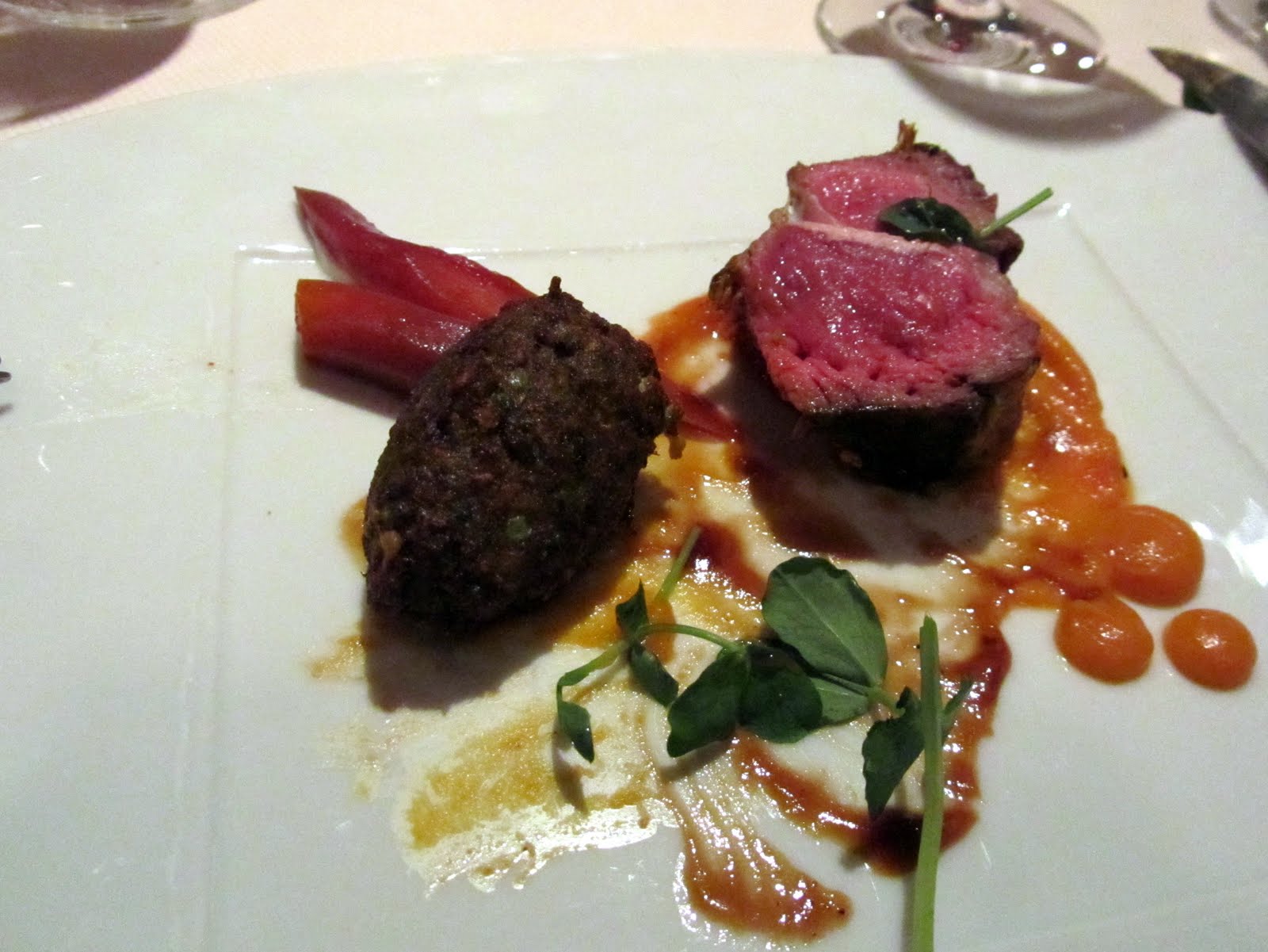
On to Earth and Sky. My choice is closer to local: Loin of Shenandoah Valley Lamb with Fresh Garbanzo Falafel, Homemade Yogurt and Baby Carrots. Michèle goes for one of her favourites, Pan Fried Veal Sweetbreads with Mushroom Butter Hollandaise, Poached Morels and Irish Peas.

I’ve scanned the winelist for something “off the beaten track” and the choice comes down to DuMOL Syrah 2007, Russian River Valley (California); 14.2% ABV. Russian River Valley is known for its cool climate varietals, but here’s Syrah, typically more at home in warmer climates. For that reason (a warm climate grape in a cool climate), I’m thinking it will go well with both the lamb and the sweetbreads (the latter usually needs a lighter wine). Aromas of blackberry and plum, gamy, and floral notes with a hint of dried herbs too. It’s black fruit and gamyness dominate on the palate. The tannins are well-integrated, holding their own with the lamb but not overwhelming the sweetbreads. Excellent finish. A good match for both.

We finish the Syrah with the cheese:
  • Monocacy Silver with Garden Rhubarb, Blood Orange and Toasted Walnut. A brie-style goat cheese from Montgomery County, on the other side of DC.
  • Pleasant Ridge Reserve with Sicilian Pistachios and Sour Cherry Filled Doughnut. A raw cows-milk cheese from Wisconsin, similar to Gruyere. Definitely our favourite.

On to Eden and, yes, we have room. Michèle selects the White Chocolate Chai Rice Pudding and my choice is the Milk Chocolate and Jameson Petit Gâteau with Caramel Sauce.  The candle is a bonus!

Great food, good wine.  What a terrific birthday treat!  Merci, Michèle!

Subscribing to this blog through RSS or email is easy! Just click on the subscribe link to the left ←

Tuesday, May 17, 2011

Kinkead's

It's one of those classic spring days, when the day dawns bright and sunny. You need a jacket in the morning, but you know that by mid-afternoon, the jacket will be off and you’ll be rolling up your sleeves.

It’s perfect weather for sightseeing and long walks, which in DC is the same thing.

Some sights (Washington Monument, Lincoln Memorial) I’ve seen many times before. Some are new since I lived here: World War II, Korean War, Vietnam War. All are impressive in their own way and all capture the historical essence that we associate with those wars: generational triumph, stalemate, and the deep gash in the national psyche.


We’ll be having a quick dinner this evening (we're off to see Pink Martini at the JFK Center).  So we make time for a long, leisurely lunch at Kinkead’s (pronounced as Kin-kaid), which styles itself as “an American Brasserie”. Seafood is the speciality.

For our mains, I choose grilled flounder, served on a bed of endives and tomatoes in a lemon sauce with capers and pickled cucumber on top. Michèle chooses the Organic Chicken, served with chanterelles, fava beans, porcini cream, and mashed potatoes. Both are superb.

The selected wine is the only Chenin Blanc on the menu: Couly-Dutheil Les Chanteaux 2009, AOC Chinon. Wonderfully fresh floral, citrus, and mineral aromas. It’s citrus and minerality on the palate with good length. Crisp, but with enough body to be a terrific match with both dishes. Great price too. Ah, Chenin Blanc from the Loire…so little respect…it’s one of the great values.


Great service that hit all the right notes. An example: they hadn't chilled the Chinon ahead of time, so the waiter gave us a couple of glasses of wine to enjoy while the Chinon chilled down to the right temperature in an ice bucket.

Watching crew teams on the Potomac
with the Watergate in the background
We walked off our terrific lunch through Georgetown, and then slowly made our way along the Potomac to the JFK Center, stopping to enjoy the sunshine along the way.  Jacket off, sleeves rolled up.

Great show by Pink Martini caps off a magnificent day.


Subscribing to this blog through RSS or email is easy! Just click on the subscribe link to the left ←

Tuesday, May 10, 2011

J&G Steakhouse

Sightseeing is hard work, requiring stamina, determination, and at the end of the day, a culinary reward.

In Washington DC, there are many things to see: from the White House to Capitol Hill, everything in-between and beyond. To be sure, you can walk everywhere. But careful…it all looks close together on the map and even in person. But because the scale of everything is so grand (quite the opposite of the intimacy of Ottawa’s downtown), objects actually are farther away than they appear.

Luckily, DC has an excellent metro system. Back when I lived here, the public transit system was a local joke. It’s just one of the many things in DC that have changed for the better.

As for our reward at the end of the day, we needed steak. There’s no shortage of steakhouses in this red meat town. We bypassed the usual suspects and opted for J&G Steakhouse, just a stone’s throw from the White House. (Not that I tried throwing stones at the White House. Ill-advised, they tell me.)

J&G Steakhouse is a Chef Jean-Georges Vongerichten restaurant. (Vongerichten is an Alsatian who is now one of those worldwide chefs.) After a salad as an appetizer, I chose the 14 oz Six Peppercorn Prime NY Steak with sides of Frites and sautéed kale while Michèle selected the 8 oz Filet Mignon. For me, steak needs to have good body and texture. Rib Eye, Hanger, New York, that’s a steak. I don’t care for steak disguised as melted butter, which is what Wagyu can often be. My steak had just the right amount of chewy texture that makes steak so enjoyable.

Our wine is the Cliff Lede Cabernet Sauvignon 2007 Stags Leap District, 14.9% ABV. It’s an almost-Meritage blend of Cabernet Sauvignon (75%), Merlot (12%), Malbec (7%), Cabernet Franc (4%), and Petit Verdot (2%). Aromas of cassis, sweet spices, and a touch of earthiness. The cassis and spice follow on the palate with soft, well-integrated tannins. Some dark chocolate on the finish. No unpleasant heat from the high alcohol level. Good length, but perhaps lacks the structure I like with a good steak.


Service at J&G is quite the opposite of our dinner at Hank’s Oyster House. Friendly, efficient, unobtrusive and, most importantly, unhurried. Oh, I’m sure they can rush an order if called upon. But, for us, we finished our wine leisurely after the main course. No sign of the dessert menu until the wine was gone. The way it should be. The restaurant was full but we felt we could have stayed there as long as we wanted.


Subscribing to this blog through RSS or email is easy! Just click on the subscribe link to the left ←

Wednesday, May 4, 2011

Hank's Oyster Bar

It’s weird to be back in Northern Virginia, in the suburbs of Washington DC. It’s where I went to high school, oh so many years ago. And except for some quick business trips to DC from time to time, I haven’t come back until now. There’s a familiarity to the place, a feeling of déjà vu. Yet so much has changed that there’s a certain strangeness, or estrangement, to the place. Like a dream.

It’s spring here. Real spring, not calendar spring.  Driving south from Ottawa, near Scranton, we can see the sharp demarcation between winter and spring, between dormancy and budburst. 

Our first dinner is at Hank’s Oyster Bar in Alexandria. It’s a popular little joint; crowded on a Tuesday evening. We get the only open table and the line-up starts forming at the door just after we sit down. But it has that typically American approach to service…fast, get ‘em in…get ‘em out…that ensures that no one is waiting for long.

It’s an oyster bar so regular readers should be in no doubt about what I’m going to order. There are 9 different types of oysters on offer. I take a dozen, 3 each of 4 different ones.

Two from the west coast:
  • Dabob Bay, light and salty
  • Little Skookum from Puget Sound, smooth and rich
Two from the east coast:
  • Bluepoint from Long Island, nothing distinctive here
  • Delaware, big and meaty
Now, Hank’s does something that I’ve never seen at an oyster bar before but it’s blindingly obvious. Instead of plunking down the plate of oysters and rattling off the names (which I can never remember just 10 seconds later), the server puts the plate down with the order ticket next to it. The shucker arranged the oysters on the plate in the same order as on the ticket, clockwise, starting at 12 o’clock. Simple, effective, clever.  No "what was this one again?"

We order Nessa Albarino 2009. Bit of a greenish tint. Typical citrus, floral, and mineral aromas. Crisp lime on the palate and just a bit of peach pit bitterness on the finish. Great match for the oysters.

I followed up with seared scallops while Michèle had the lobster roll. The food was delicious (bit too salty) but the Albarino was too light-bodied with these choices.  Ah well, nobody's perfect.

Hank’s: good oysters, good (but too fast) service.


Subscribing to this blog through RSS or email is easy! Just click on the subscribe link to the left ←

Thursday, January 20, 2011

Recommended Reading: Making Sense of Wine

I remember Matt Kramer from back in the days when I read Wine Spectator. He’s been a regular contributor there since the mid-80s and reading his column was often a highlight. Perhaps Kramer is best known for his translation of Terroir as “somewhereness”, which just goes to show that some concepts are better left untranslated. But let’s not hold that against him.

Yes, Matt Kramer is an advocate of the concept of Terroir so, right away, we are comrades-in-vino. And I’m right with him when he mourns the homogenization of wines,
The greatest challenge today is to recognize ‘originals’...I believe more strongly than ever that both searching for and finding originals is a wine lover’s greatest pleasure…great wines taste like they come from somewhere. Lesser wines taste interchangeable; they could come from anywhere.
So many Cabernet Sauvignons and Chardonnays from countless different regions taste like they came from some McVino franchise. Perhaps the greatest service that wine scorers can do for us (if you rely on scores to buy your wines) is to score wines as much on originality as what Kramer argues is the most important criterion: complexity.

Perhaps my favourite chapter is The Wine Cellar – Are you Ready for Reality? where Kramer tackles the purported effects of humidity, vibration, temperature, light, and shipping on wine. Many of these threats, he argues convincingly, have been vastly overstated. As one example, the long-standing recommendation that we should keep wines in a humidity-controlled room stems from way back when wines were stored in barrels, hardly something that is common today outside of the winemaker’s cellar. Once bottled (sealed in glass), humidity is largely irrelevant to a wine’s condition.

The last chapter, Food Is the Meaning of Wine, starts off,
Wines exist for food. Without the context of food, wine is a eunuch, a sterile experience which soon acquires distorted features.
This is the point that so many New World winemakers miss, that a good wine becomes great only as a partner to food.

Much of Kramer’s writing still makes sense. He writes extremely well and reading something so well written about pleasure is in itself, well, a pleasure.

That’s not to say that everything that Kramer offers makes sense. He argues that the best way to appreciate a wine is to experience its evolution over time, and that the only way to do that is to buy a case of each wine that you buy. (It’s a oft-recommended wine-buying strategy.) A few pages later, he encourages buying wines from many different regions, and even buying different wines from the same region to appreciate their differences. Again, a good buying strategy. But buying a case each of different wines from within a region, and from many different regions, is a strategy only for the independently wealthy aficionado with a very large cellar! As for the rest of us, we can do one, or the other (even then, if we’re lucky). Me, I choose variety.

Kramer added a chapter for the second edition of this book: Twenty-First Century Fine Wine – The Consequences of Success. It’s worth reading just for his summary of the technological revolution (some might say trickery) that’s been brought to winemaking in the past 20 years. It's a revolution that he blames mostly on the Australians, who are not pleased. But the counter-revolution has already begun, even in Australia, at least at the level of fine wine. More wine writers and drinkers are seeking out originality. (See Beppi Crosariol’s column in the January 15 Globe and Mail…and most any post in this blog.)

Making Sense of Wine was originally published in 1989, with this second edition published in 2003. (Yes, I’m still catching up on my wine reading.)

Definitely worth keeping a copy on your bookshelf.

Subscribing to this blog through RSS or email is easy! Just click on the subscribe link to the left ←
Thursday, December 16, 2010

La Bovedas

After driving south from Chiclayo to Trujillo, dinner is at La Bovedas, located in the Hotel Libertador.


We start with a refreshing Sauvignon Blanc from Chile, matched to my Halibut cebiche, with manioc (yucca), corn, sweet potato with some leche de tigre on the side.  Michèle takes a salad of green asparagus, artichokes, mushrooms, and spinach with bell pepper vinaigrette.

For the main course, Michèle takes the Grilled Halibut, Sautéed Vegetables with Tarragon and Cumin, in an Asparagus Soup. (She loves her asparagus! And Peru is the world’s leading exporter, so why not enjoy it as fresh as it is here?)

My choice is North Shore Grouper Fillet, Sautéed Parsley, and Stir-Fried Potatoes. It’s all brilliant!

My choice for a matching wine is La Linda Viognier 2008 (from Leoncio Arizu), Mendoza (Argentina) 14.5% ABV. Deep yellow colour, aromas of apricot, pineapple, almond, sweet spice and floral notes. The apricot flavour dominates on the palate. Medium acidity, it’s round at first but with a bite of crisp acidity on the finish, along with some bitterness. Interesting change through the palate! It matches up well with both dishes.

Dessert for me is Tres Leches (this time the 3 “milks” are coffee cream, Baileys, and condensed milk) …Almond bavarois with amaretto, caramel, and orange sauce with Cointreau for Michèle.

Definitely the place to be in Trujillo. In fact, we liked it so much we went back two days later for lunch, just before heading back to Lima and home.


Michèle’s appetizer was Spicy Shrimp and Corvina with (wait for it) Green Asparagus and Potatoes. My choice is North Pacific Salmon in a Ginger Sesame Sauce.  Both dishes reflect the Asian influences in Peruvian cuisine.  Superb.

For the main course, I take a classic regional dish: Cabrito con Tacu Tacu (baby goat with grilled rice and beans) and Michèle orders the Alpaca Filet Mignon on a bed of vegetables. Delicious.

Our final Peruvian wine: You guessed it…Tacama Seleccion Especial 2008, Ica Valley, 14% ABV. A blend of Tannat and Petit Verdot. We tried the 2009 earlier in the trip. Consistent aromas and flavours of red and black fruits, anise, and black pepper. I found the 2009 to have some grippy tannins but with an extra year of aging, the 2008 is softer and better integrated with the fruit on the finish.

A wonderful way to while away an afternoon and finish our wine and food adventures in Peru.  If this is the world's emerging style of fine cuisine, count me in!


Subscribing to this blog through RSS or email is easy! Just click on the subscribe link to the left ←

Tuesday, December 14, 2010

Big Ben

Flying north from Lima, we spent a couple of days in Chiclayo, visiting the ruins at Sipan, where we began to learn about one of the most fascinating pre-Incan civilizations: the Moche. Not much to say about the cuisine in Chiclayo. Most remarkable was our dinner at Neuva Nueva Venecia, a very busy pizzeria about halfway between our hotel and the Plaza de Armas. Great, thin-crust pizza. A half-litre of a good red wine for $2!

From Chiclayo, we motored south to Trujillo, the 3rd largest city in Peru. Here the main attractions are from the Chimu civilization: the Huaca de la Luna and the ruins of Chan Chan, the largest pre-Columbian city in South America. We’re getting a much greater appreciation for the size and sophistication of these civilizations. The Europeans didn’t bring civilization to the Americas, they brought a different civilization to the Americas…and not an entirely better one.

At midday, we drive out to Huanchaco, right on the Pacific, for lunch at Big Ben. Although it has some interesting specialities, for lunch all we need is something simple and fresh.

My choice is grilled Corvina with fries. Michèle takes a grilled Corvina with mushrooms and white asparagus in a garlic sauce. Freshly caught that morning, the fish is Mmm...Mmm...good.

And the perfect accompaniment is the local beer, Pilsen Trujillo. Light yellow colour, crisp, not the best pilsner I’ve ever tasted but sometimes sentiment wins out over flavour!  Served with a bowl of the addictive cancha (roasted corn).

Subscribing to this blog through RSS or email is easy! Just click on the subscribe link to the left ←

Monday, December 6, 2010

La Trattoria di Mambrino

Back to Miraflores, for a day, before we head up to northern Peru, off the beaten track for tourists! After my gastro misadventure, it’s good to have my appetite back, although slow and easy does it. 

Miraflores is part of metropolitan Lima and reflects the many cultural influences that make Lima a cosmopolitan city, and a culinary delight. For lunch, we head to Wa Lok, a “chifa”, what Peruvians call a Chinese restaurant. It’s a Sunday, a day when many Peruvian families get together for lunch. The restaurant is full when we arrive at 1:30, but the turnover is fast and there’s no trouble getting a table. It’s a very typical Chinese restaurant: the service is quick, if impersonal, and the food is great. Highly recommended.

For dinner, it’s time for some comfort food…pasta at La Trattoria di Mambrino, just a short walk from our hotel.

My choice is Tagliatelle with a Veal Porcini Ragu. Delicious, the sauce just coats the pasta and the mushroom favour really comes through.

Michèle takes Spaghetti Carbonara with Asparagus. They go easy on the cream, so what can sometimes be a heavy, rich dish is unexpectedly lighter, and tasty. And with fresh Peruvian asparagus, it’s a real treat.

The winelist carries an Argentinean Merlot at a reasonable price, so I order that. I guess I found a popular choice, because there’s none left. The sommelier brings another Argentinean Merlot, asking if we’d to have this one instead. Now, I’m a quick study with restaurant winelists. So I remember that this new one is about $40 more expensive. I also remember that there’s a Chilean Merlot. It's about the same price as the Argentinean one I wanted.

OK, this guy didn’t go to the same sommelier school that I did. First, you know your inventory well enough to know when you’re out of something, and tell the client right away when he makes his order. Failing that, then second, you don’t come back with another bottle, you come back with the winelist, allowing the client to choose something from the full list. Failing that, then third, you don’t come back with a much more expensive bottle, you come back with something in the same price range. But hey, we’re tourists, so you have to keep your head up!

We order the Cousino-Macul Antiguas Reservas Merlot 2008, Maipo Valley, Chile; 14% ABV. Aromas of blackberry and blueberry, sweet spices (vanilla); the dark fruits coming through again on the palate. Medium acidity and tannins, perhaps a bit young, it’s not quite full-bodied. Great with the food! Merlot is my favourite “International Varietal” to match with many pasta dishes.

Time for dessert. Michèle takes Queso Helado, which we first tried in Arequipa. Smooth and good.

My choice is Tres Leches, a cake soaked in 3 kinds of milk: evaporated milk, condensed milk, and heavy cream. The cake itself is light, and soaks up just enough liquid without falling apart. It some ways it’s the South American version of tiramisu. Mmmmm…definitely comfort food.


Subscribing to this blog through RSS or email is easy! Just click on the subscribe link to the left ←